Enquire Now
Geotechnical Investigation UAE | Soil Testing, Borehole Drilling & Engineering Services in Dubai, Abu Dhabi & Al Ain
Geotechnical investigation UAE provides essential subsurface information for safe, reliable, and technically sound construction projects across Dubai, Abu Dhabi, Al Ain, Sharjah, and other Emirates. Before foundation work, excavation, earthworks, or major infrastructure construction begins, engineers need to understand the soil profile, groundwater conditions, bearing characteristics, strength, density, and subsurface materials at the proposed site.
From high-rise developments and commercial projects in Dubai to major infrastructure, industrial, and coastal developments in Abu Dhabi and residential projects in Al Ain, ground conditions can vary significantly from one site to another. A carefully planned geotechnical investigation helps identify these conditions and provides engineering data for foundation design, excavation planning, earthworks, pavement design, and construction decisions.
SmartGeo combines field investigation, borehole drilling, in-situ testing, soil sampling, laboratory analysis, and complementary geophysical techniques to provide project-specific geotechnical investigation services in UAE.
What Is a Geotechnical Investigation?
A geotechnical investigation is a systematic assessment of subsurface conditions at a construction or development site. The investigation typically involves reviewing available site information, planning investigation locations and depths, drilling boreholes, collecting soil and rock samples, carrying out field tests, conducting laboratory analysis, and preparing an engineering report.
The investigation provides information about soil and rock layers, groundwater conditions, density, strength, bearing characteristics, and other relevant ground properties. This information helps engineers make better-informed decisions regarding foundations, earthworks, excavation, construction methods, and other engineering requirements.
The scope of a geotechnical investigation in UAE should be developed according to the proposed development, site conditions, structural requirements, project specifications, and applicable engineering standards.
Why Is Geotechnical Investigation Important in the UAE?
The UAE contains a range of geological and ground conditions. Depending on the project location, construction sites may encounter desert sands, coastal deposits, reclaimed ground, weathered materials, dense formations, and rock layers.
These conditions can affect foundation performance, settlement, excavation requirements, groundwater management, earthworks, road construction, and overall project planning. Reliable subsurface information therefore helps reduce uncertainty before major construction activities begin.
A professional geotechnical investigation can help project teams:
- Understand subsurface soil and rock conditions
- Identify changes between different ground layers
- Evaluate relevant soil engineering properties
- Assess groundwater conditions
- Support foundation design and engineering assessment
- Evaluate bearing and settlement considerations
- Plan excavation and earthwork activities
- Assess subgrade conditions for roads and infrastructure
- Identify potential ground-related construction challenges
- Develop project-specific construction recommendations
Geotechnical Investigation Process in UAE
A typical ground investigation follows several stages. However, the exact scope and testing program depend on the project objectives, site conditions, proposed structure, investigation requirements, and applicable specifications.
1. Site Information Review
The investigation begins with a review of available information about the proposed site. Engineers may consider geological information, previous investigation reports, site plans, topographic information, proposed structural details, development layouts, and other relevant project documents.
2. Investigation Planning
The investigation team determines suitable investigation locations, depths, sampling requirements, field testing methods, and laboratory testing requirements. The investigation plan should reflect the proposed development and the expected subsurface conditions.
3. Borehole Drilling
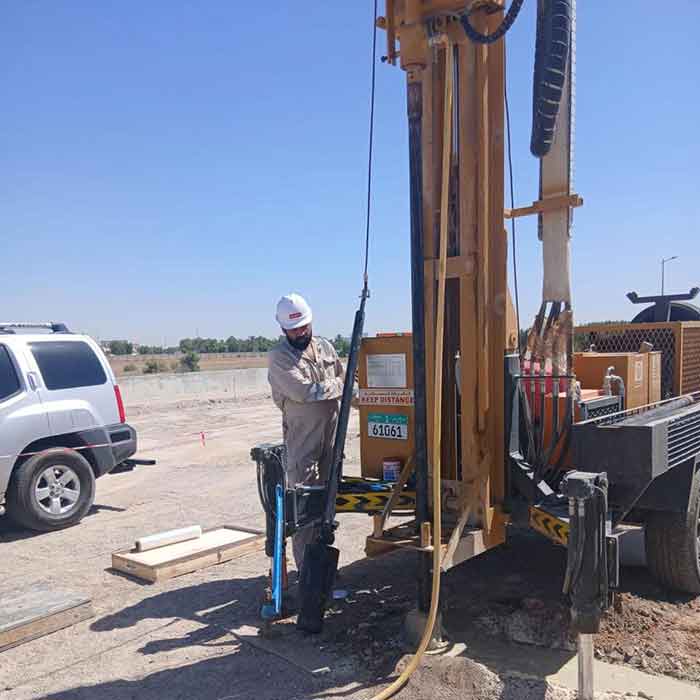
Borehole drilling allows engineers to investigate soil and rock layers below the ground surface. Samples collected from selected depths can be used for laboratory testing and engineering assessment.
For more information, see our borehole drilling services in UAE.
4. In-Situ Testing
Field testing provides direct information about subsurface materials at the investigation location. Depending on the project requirements, methods may include Standard Penetration Testing (SPT), Cone Penetration Testing (CPT), permeability testing, plate load testing, and other appropriate field investigations.
5. Soil and Rock Sampling
Representative soil and rock samples are collected from selected depths for laboratory evaluation. Proper sampling, identification, preservation, and handling help maintain the quality and reliability of the resulting test data.
6. Laboratory Testing
Laboratory testing provides detailed information about selected physical, chemical, and engineering properties of soil and rock samples. The laboratory testing program is determined according to the project requirements and materials encountered during field investigation.
7. Engineering Assessment and Reporting
Field and laboratory results are reviewed by the technical team and incorporated into a geotechnical report. Depending on the project scope, the report may include subsurface profiles, test results, groundwater observations, engineering assessments, foundation considerations, earthwork recommendations, and other relevant findings.
Borehole Drilling and Subsurface Investigation
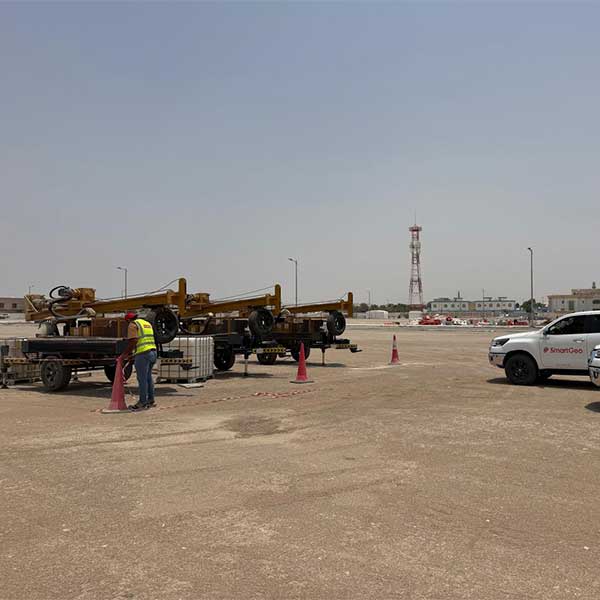
Borehole drilling forms an important part of many geotechnical investigation programs. It allows engineers to examine subsurface materials at different depths and collect representative samples for further assessment.
Depending on site conditions and project requirements, drilling activities may include:
- Rotary drilling
- Percussion drilling
- Soil sampling
- Rock core sampling
- Standard Penetration Testing
- Groundwater observations
- Subsurface layer identification
- Borehole logging and documentation
Combining drilling results with in-situ testing and laboratory analysis provides engineers with a more complete understanding of the ground conditions beneath the proposed development.
In-Situ Geotechnical Testing
In-situ testing evaluates ground conditions directly at the project site. These tests complement borehole information and laboratory results by providing measurements from soil or ground materials in their natural position.
Standard Penetration Test (SPT)
The Standard Penetration Test provides field data that can help engineers assess soil resistance and subsurface conditions. SPT is commonly performed during borehole investigations where this information is required for geotechnical assessment.
Cone Penetration Test (CPT)
Cone Penetration Testing provides continuous subsurface measurements as the cone advances through the ground. The resulting data can help engineers evaluate soil behaviour, identify changes between layers, and support geotechnical interpretation.
Plate Load Testing
Plate load testing evaluates the response of near-surface soil to applied loading. Depending on the project requirements, the results can provide useful information for foundation, pavement, and subgrade assessments.
Permeability Testing
Permeability testing helps assess how readily water can move through soil. This information may be relevant to drainage design, groundwater assessment, earthwork planning, and other engineering considerations.
Geophysical Investigation Support
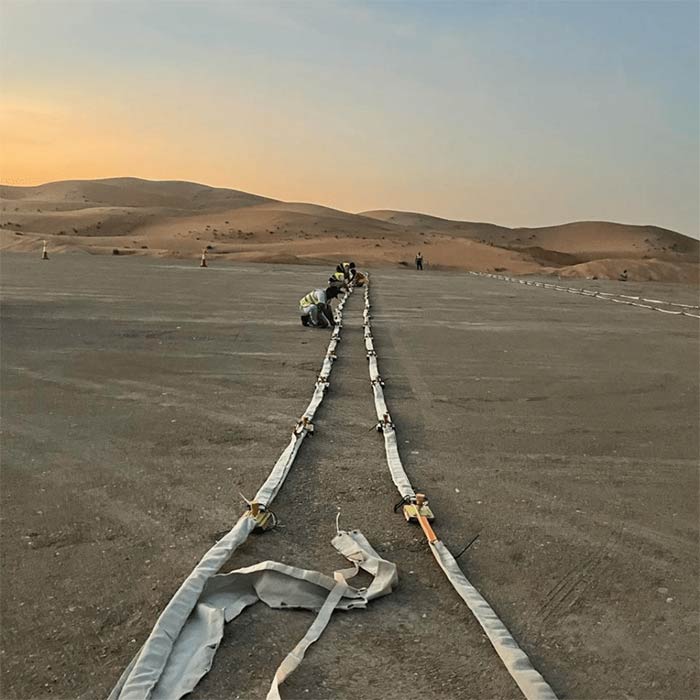
Some projects require additional subsurface information beyond conventional drilling and field testing. In these situations, geophysical investigation can complement traditional geotechnical methods.
Depending on the project objectives and site conditions, SmartGeo can support investigations using techniques such as:
- Geophysical survey UAE for subsurface investigation and mapping
- GPR survey for detecting selected underground features and anomalies
- MASW and ERT surveys for evaluating subsurface characteristics
Geophysical techniques can provide additional information between investigation points and may help project teams develop a broader understanding of subsurface conditions. The appropriate method should be selected according to the project objectives, expected ground conditions, and required investigation depth.
Soil Laboratory Testing for Geotechnical Investigation
Laboratory testing provides detailed measurements of selected soil and rock properties using samples collected during field investigation. The testing scope depends on the soil type, project requirements, applicable specifications, and engineering objectives.
Common laboratory evaluations may include:
- Soil classification
- Moisture content
- Particle size distribution
- Density testing
- Compaction testing
- Atterberg limits
- Soil strength testing
- Consolidation testing where required
- Chemical analysis where required
- Other project-specific geotechnical tests
SmartGeo provides geotechnical laboratory testing in UAE to support construction and engineering projects.
For broader laboratory capabilities, you can also explore our soil and material testing laboratory services.
Geotechnical Investigation and ISO-Based Quality Practices
Quality control and reliable testing procedures are important components of professional geotechnical investigation. Field measurements, sampling, laboratory testing, documentation, and reporting should be carried out using appropriate procedures and applicable project requirements.
Where applicable, geotechnical and laboratory activities may be aligned with relevant international standards and established testing procedures. ISO-based quality management and laboratory practices can help support consistency, traceability, documentation, and confidence in testing results.
For projects requiring accredited laboratory testing, the applicable accreditation, test methods, scope, and standards should always be confirmed for the specific service and project requirements.
Geotechnical Investigation for Foundation Design
Foundation design depends on the interaction between the proposed structure and the underlying ground. Reliable information about soil and rock conditions can therefore help engineers assess suitable foundation approaches.
Geotechnical investigation data may contribute to assessments involving:
- Soil bearing conditions
- Settlement considerations
- Subsurface variability
- Soil and rock strength
- Groundwater conditions
- Excavation conditions
- Foundation depth considerations
- Ground improvement requirements where applicable
The investigation findings form part of the technical information engineers use when developing foundation and structural solutions.
Geotechnical Investigation for Roads and Infrastructure
Geotechnical investigation also plays an important role in roads, highways, bridges, industrial yards, utility corridors, airports, and other infrastructure projects.
For these developments, engineers may require information about subgrade materials, soil strength, compaction characteristics, groundwater, settlement potential, and variations in subsurface conditions.
Field investigation and laboratory testing can therefore support pavement planning, earthwork assessment, foundation design, subgrade evaluation, and construction quality control.
Geotechnical Investigation in Dubai
Geotechnical investigation Dubai projects can involve a wide range of developments, including high-rise buildings, residential communities, commercial properties, industrial facilities, roads, infrastructure, and waterfront developments.
Dubai’s rapid development has resulted in construction across different ground environments. Urban sites, coastal areas, reclaimed land, and large development zones may require different investigation approaches.
Accordingly, project-specific borehole drilling, field testing, soil sampling, laboratory analysis, and complementary geophysical investigation can provide useful information for engineering design and construction planning.
Geotechnical Investigation in Abu Dhabi
Geotechnical investigation Abu Dhabi services support residential, commercial, industrial, infrastructure, coastal, and large-scale development projects across the emirate.
Abu Dhabi includes coastal environments, developed urban areas, industrial zones, reclaimed areas, and extensive infrastructure projects. Subsurface conditions can therefore vary significantly between project locations.
A suitable geotechnical investigation in Abu Dhabi can provide engineers with information about soil layers, groundwater, material properties, bearing characteristics, and other relevant ground conditions. These findings can support foundation design, earthwork planning, excavation assessment, and construction decisions.
For projects in Abu Dhabi, the investigation scope should be selected according to the proposed structure, site conditions, project specifications, and applicable engineering requirements.
Geotechnical Investigation in Al Ain
Al Ain presents its own range of geological and ground conditions. Construction projects may encounter variable soil layers, weathered materials, dense deposits, and rocky formations depending on the site.
As a result, drilling, field testing, sampling, and laboratory analysis should reflect the characteristics of the proposed development and the conditions identified during the investigation.
Project-specific geotechnical investigation helps engineers obtain reliable information before foundation and major earthwork activities begin.
Marine and Offshore Geotechnical Investigation
Marine and offshore developments require specialized investigation methods because engineers must assess subsurface conditions beneath water.
For ports, waterfront developments, bridges, marine structures, and offshore projects, investigation programs may include:
- Marine CPT testing
- Marine geotechnical investigation
- Sub-bottom profiling
- Marine sediment sampling
- Bathymetric surveying
- Offshore geotechnical drilling
- Ground and seabed condition assessment
Specialized marine investigation provides information that can support the design and construction of structures located in coastal and offshore environments.
Why Choose SmartGeo for Geotechnical Investigation?
Choosing an experienced geotechnical service provider can help project teams obtain reliable field and laboratory information for engineering decisions. SmartGeo combines field investigation capabilities, laboratory testing, engineering expertise, and complementary survey technologies.
Our capabilities include:
- Experienced geotechnical engineers and technical personnel
- Borehole drilling and subsurface investigation
- In-situ geotechnical testing
- Soil and geotechnical laboratory testing
- Geophysical investigation support
- Marine and offshore investigation capabilities
- Technical reporting and engineering data
- Project-specific investigation planning
- Project support across Dubai, Abu Dhabi, Al Ain, Sharjah, and other UAE locations
What Information Is Needed to Plan a Geotechnical Investigation?
Before preparing an investigation program, engineers may require basic information about the proposed project. Providing accurate project details can help determine a suitable field and laboratory testing scope.
Useful information may include:
- Project location
- Site plan or development layout
- Type of proposed structure
- Number of floors or approximate structural requirements
- Proposed foundation type, if known
- Site access conditions
- Available previous investigation reports
- Project specifications and testing requirements
- Required investigation depth, if already specified
With this information, the investigation team can develop a more suitable field investigation, sampling, in-situ testing, and laboratory testing program.
Frequently Asked Questions About Geotechnical Investigation UAE
What is the purpose of a geotechnical investigation?
The primary purpose is to obtain reliable information about subsurface conditions for engineering and construction planning. The results can support foundation design, earthwork planning, groundwater assessment, excavation planning, and other project decisions.
What is included in a geotechnical investigation?
Depending on the project requirements, the scope can include site information review, investigation planning, borehole drilling, soil and rock sampling, in-situ testing, groundwater observations, laboratory analysis, engineering interpretation, and technical reporting.
Is borehole drilling always required?
Not every project requires the same investigation method. The need for boreholes depends on the project type, site conditions, structural requirements, investigation objectives, required investigation depth, and applicable project specifications.
What is the difference between geotechnical investigation and soil testing?
Geotechnical investigation is a broader process that examines subsurface conditions through fieldwork, sampling, testing, analysis, and reporting. Soil testing refers more specifically to individual field or laboratory tests used to determine selected soil properties.
Why is geotechnical investigation important in Dubai and Abu Dhabi?
Dubai and Abu Dhabi contain diverse development environments and ground conditions. A site-specific investigation provides engineers with information about actual subsurface conditions instead of relying only on assumptions or generalized geological information.
Can geophysical surveys be used with geotechnical investigation?
Yes. Geophysical methods can complement boreholes and conventional field testing by providing additional information about subsurface conditions between investigation points. The appropriate method depends on the project objectives, expected ground conditions, and site characteristics.
What geotechnical tests are commonly carried out in the UAE?
Depending on the project, commonly used investigations and tests may include borehole drilling, Standard Penetration Testing (SPT), Cone Penetration Testing (CPT), soil sampling, laboratory classification, compaction testing, particle size analysis, strength testing, permeability testing, and other project-specific assessments.
How does geotechnical investigation support foundation design?
The investigation provides information about soil and rock conditions, strength, bearing characteristics, groundwater, subsurface variability, and settlement-related considerations. Engineers can use this information as part of the technical basis for evaluating appropriate foundation solutions.
Does SmartGeo provide geotechnical investigation in Abu Dhabi?
Yes. SmartGeo provides geotechnical investigation services for projects in Abu Dhabi, including borehole drilling, in-situ testing, soil sampling, laboratory analysis, geophysical support, and technical reporting, depending on project requirements.
Does SmartGeo provide geotechnical investigation across the UAE?
SmartGeo provides geotechnical investigation, soil testing, borehole drilling, laboratory testing, and related engineering services for projects across Dubai, Abu Dhabi, Al Ain, Sharjah, and other areas of the UAE.
Conclusion
Geotechnical investigation UAE provides essential ground information for construction planning, foundation engineering, infrastructure development, excavation, earthworks, and other engineering projects. By combining borehole drilling, in-situ testing, soil sampling, laboratory analysis, and complementary geophysical methods, engineers can develop a clearer understanding of subsurface conditions.
Whether a project is located in Dubai, Abu Dhabi, Al Ain, Sharjah, or another part of the UAE, a project-specific investigation can help reduce uncertainty and provide valuable information for engineering and construction decisions.
SmartGeo supports developers, consultants, contractors, and engineering teams with geotechnical investigation, soil testing, borehole drilling, laboratory analysis, geophysical investigation, and related services across the UAE.
Explore SmartGeo’s geotechnical investigation and engineering services in UAE.